Would you like to switch to the accessible version of this site?

Go to accessible site Close modal window

Don't need the accessible version of this site?

Hide the accessibility button Close modal window
Accessibility View Close toolbar
Menu
  • Home
  • New Patient Center
    • What to Expect
    • Veterinary Resources
    • Payment Options
  • About Us
    • Services
    • Meet our team
  • Petsimonials
  • Contact Us
  • Blog
  • Veterinary Topics
    • Pet Health
      • Chronic Conditions
      • Digestive and Oral Health
      • Diseases and Viruses
      • Pests and Parasites
      • Orthopedics
    • Today's Veterinarian
    • Choosing Your Pet
      • Finding Your Pet
      • Cats
      • Dogs
      • Exotics
        • Amphibians
        • Birds
        • Reptiles
          • Lizards
          • Turtles
      • Small Mammals
        • Ferrets
        • Rabbits
        • Domesticated Animals
          • Prairie Dogs
        • Pocket Pets
          • Chinchillas
          • Guinea Pigs
          • Hamsters
          • Hedgehogs
          • Rats
      • Livestock
        • Cows
        • Donkeys, Horses & Mules
        • Goats
        • Pigs
        • Poultry
        • Sheep
    • Living With Your Pet
      • Bringing Your Pet Home
      • Children and Pets
      • Providing Care
      • Travel
      • Saying Goodbye
    • Newsletter Library
      • Cats
      • Tips for Pet Owners
      • Behavior & Training
      • Fleas & Parasites
      • Keeping Pets Healthy
      • Recognizing Illness
      • Nutrition & Food
      • Pet Dangers
      • Seasonal Topics
      • Visiting the Vet
      • Equine
      • Newsletter Archive
        • Fun with Pets
        • Unbelievable Pets
    • Video Newsroom
      • Health Topics
      • Technology and Science
      • Other Interests
    • Newsletter Library
    • Client Survey
    • Pets4Kids

Roxy Ann Veterinary Hospital

541-664-1521

Exclusive Offer

First Visit is FREE

Sign up now

Error!

    • Home >
    • Articles >
    • Feline >
    • Pet Health >
    • Diseases and Viruses >
    • Ringworm in Cats

    Ringworm in Cats

    • Created in Feline, Pet Health, Diseases and Viruses
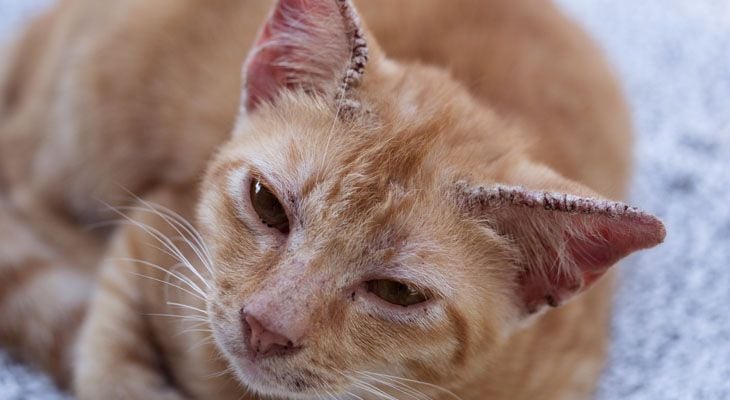
    ringworm on a cat
    Ringworm is a common skin condition in cats. In spite of its name, this condition is actually caused by a fungus, not a worm. One of the symptoms, though, is a circular rash on the skin that resembles a ring. However, this ring does not always appear.

    Cause of Ringworm

    The fungi that cause ringworm come from the soil, but can easily live in a host. These fungi are known as dermatophytes. Once inside a cat’s body, the fungi digest a protein substance called keratin that is found in nails and hair. They use keratin as fuel to help them reproduce. Over time, the fungi can produce millions of single-celled spores that can grow into new fungi.

    When a cat comes into contact with these fungi, it does not always become infected. The fungi may not be able to attach to the skin or may lose out to other microorganisms that are already living there. Even if the fungi are able to stay on the skin, they may not cause any symptoms. However, in some cats, these fungi can result in inflammation of the skin (dermatitis).

    Ringworm may clear up on its own, but can take up to a year to go away. During that time, the cat’s fur may fall out in the affected area. This can increase a cat’s chance of developing open wounds in the skin—such as from scratching—and other kinds of infections. Ringworm can also be passed from an infected cat to a person through close contact.

    Symptoms of Ringworm

    The symptoms of ringworm in cats include:

    • Loss of hair in circular patches
    • Hair that becomes broken or stubbly
    • Crusty or scaly skin
    • Changes in skin or hair color
    • Inflammation on the skin
    • Excessive scratching and grooming
    • Infections in the nail beds or claws
    • Dandruff

    Diagnosis and Treatment

    Diagnosing ringworm involves ruling out other possible skin conditions that can produce similar symptoms, such as an allergy to flea bites. A feline veterinarian may use an ultraviolet (UV) light to look at the cat’s fur. Hairs that are coated with fungus will glow yellow-green under the UV light. These hairs can then be looked at under a microscope to see if spores or other signs of the fungus are present.

    Treatment for ringworm in cats usually involves the use of anti-fungal medications. This is applied to the infected areas of the body. The cat may also be given an oral anti-fungal medication. The treatment will need to be repeated several times for at least six weeks. For widespread infections, the cat may need to undergo a full-body dip in the medication.

    • Pet Health
      • Chronic Conditions
      • Digestive and Oral Health
      • Diseases and Viruses
      • Pests and Parasites
      • Orthopedics
    • Today's Veterinarian
    • Choosing Your Pet
      • Finding Your Pet
      • Cats
      • Dogs
      • Exotics
        • Amphibians
        • Birds
        • Reptiles
          • Lizards
          • Turtles
      • Small Mammals
        • Ferrets
        • Rabbits
        • Domesticated Animals
          • Prairie Dogs
        • Pocket Pets
          • Chinchillas
          • Guinea Pigs
          • Hamsters
          • Hedgehogs
          • Rats
      • Livestock
        • Cows
        • Donkeys, Horses & Mules
        • Goats
        • Pigs
        • Poultry
        • Sheep
    • Living With Your Pet
      • Bringing Your Pet Home
      • Children and Pets
      • Providing Care
      • Travel
      • Saying Goodbye
    • Newsletter Library
      • Cats
      • Tips for Pet Owners
      • Behavior & Training
      • Fleas & Parasites
      • Keeping Pets Healthy
      • Recognizing Illness
      • Nutrition & Food
      • Pet Dangers
      • Seasonal Topics
      • Visiting the Vet
      • Equine
      • Newsletter Archive
        • Fun with Pets
        • Unbelievable Pets
    • Video Newsroom
      • Health Topics
      • Technology and Science
      • Other Interests
    • Newsletter Library
    • Client Survey
    • Pets4Kids

    Contact Us

    Send us an email

    Error!

      Location

      Find us on the map

      Office Hours

      Our Regular Schedule

      Roxy Ann Veterinary Hospital

      Monday:

      8:00 am-5:00 pm

      Tuesday:

      8:00 am-5:00 pm

      Wednesday:

      8:00 am-5:00 pm

      Thursday:

      8:00 am-5:00 pm

      Friday:

      8:00 am-5:00 pm

      Saturday:

      8:00 am - 9:00 am for pickups only

      Sunday:

      Closed

      • Copyright © 2026 MH Sub I, LLC dba iMatrix.
      • Admin Log In
      • Site Map